Sunday, March 29, 2015

Teaching Children About Emotions

 
Teaching children to appropriately express their feelings is tied not only to developing beneficial lifelong social skills but to mental and physical health. The foundation for learning how to express one’s feelings starts with a strong foundation of a loving environment in early childhood. 

Listening/Acknowledgement
Learning how to appropriately express feelings begins with parental acknowledgement of feelings as valid. When parents are approachable and take their children’s emotional pain seriously, this creates an environment where children are not afraid to express themselves and have no need to shut down or “stuff” their emotions which can cause a variety of problems later on.

The first step is to encourage children to talk is to listen. Avoid trying to fix or explain away the pain rather than just listening. Rushing to fix a situation can gloss over the core issue. Remember to show empathy before explanation. Empathy is seeing the situation from the child's point of view. For example, if your child came to you crying and saying he had a bad dream, don't rush to fix the problem. Acknowledge your child's fear first, let him express it and talk about what scared him in the dream. Only after some time, then you can explain that it was only a dream. Skipping the first step of empathy devalues the child's emotions and experience. 

Be present in the moment, not distracted if your child is trying to tell you about his feelings. Working with feelings can be uncomfortable. Do your best to listen with empathy even if you can’t relate to the intensity of the emotion. That dead butterfly can be earth shattering to your child. Give him some space to express that pain and know that you will lovingly support him.

Identify/Name
Parents should help children learn to identify and name their feelings. This can be accomplished by simply helping the child name the feeling by saying something like “You look frustrated because you’re having trouble putting on your shoe.” Help your child develop a vocabulary for feelings: happy, sad, angry, frustrated, shy, bored, lonely, etc.. There are many books for children about feelings such as The Way I Feel by Janan Cain, The Blue Day Book by Bradley Trevor Greive, The Feelings Book by Todd Parr, Hands are Not for Hitting by Martine Agassi, Cool Down and Work Through Anger by Cheri J. Meiners.

Appropriate Outlets
It is vital for children to learn appropriate ways to not only talk about their feelings but to have an outlet for the energy of them as well. It’s not OK for children to scream or say mean or inappropriate things to people because they are upset or angry. If your child screams at you, then you should let him/her know by saying “I’ll be happy to hear what you have to say after you calm down.”  Teach appropriate outlets to “blow off steam” in order to give physical expression to the energy of the emotion. Work with your child to find what works for him/her (and is acceptable to you) such as hit a pillow, scream into a pillow, run around the yard or push hands on the wall or tree. Many of the books listed above have some great ideas for dealing with anger or frustration. Help your child transition to positive mood changers, but not too quickly. Trying to rush the process of venting can leave unresolved tension. Mood lifters can include listening and singing to music, dancing, drawing or reading. Any kind of fun activity can change the mood into something more positive.

Communication
Teach children how to communicate their feelings with other children and their siblings. Many Montessori classrooms teach a method of conflict resolution often referred to as an “I-message” and follows a basic formula of stating “I feel ____ when you do _____”. There are many variations of this but the basic idea is to help children to express feelings and help others connect their actions and the impact it has on others. An example could include “I feel angry when you keep bumping into my table while I am working. Please stop.” The child who received the message cannot walk away or ignore the message. They must at least state that they heard the message. This is important because children must feel confident that they will be heard when they talk about their feelings with others.  Adults must coach this type of interaction in the beginning until children naturally begin to utilize it with others.

All of this may seem like a lot of work but it is so important. An emotionally healthy child is confident that his/her feelings matter and will be taken seriously by his/her parents and other people. The child has the tools to identify feelings and knows how to appropriately work with them and talk about them with others. These skills lay a lifelong foundation for healthy social interaction.   Learning early on in life about how to work with emotions in a healthy way can benefit not only social skills but overall health as well. Mysterious stomach aches, headaches and other types of pain often have an emotional component to them.  Much of this can be avoided by learning to accept all emotions as valid and finding acceptable ways to work with them in a community of supportive people.

Marla Nargundkar, AMI Montessori Guide at Tree of Life Montessori School in Doraville/Atlanta, Georgia www.treeoflifemontessori.com


Monday, March 9, 2015

The Value of Chores

Rinsing dishes and loading into dishwasher
Chores, chores, chores, what a bore! Or are they? As adults we often view chores as drudgery. We often miss out on the many benefits that doing these daily tasks can have not only for ourselves but for our children. It may seem old fashioned to expect children to do daily chores but in this age of computer time, hands-on work and experience is more important than ever. We may be tempted to put academics and schoolwork above having home responsibilities, but this ignores the benefits of physical work.

So what are the values of doing regular chores?  First and foremost, chores show the child that he/she is part of a larger community and thus has responsibilities not only to him/herself but to the group at large. This community is interdependent and each member’s effort is important to keep everything running smoothly. Doing chores requires learning hands-on physical skills. Moving the body in a coordinated and purposeful way not only benefits the health of the body but the development of the brain. When children learn how to perform certain tasks such as doing laundry, cooking, cleaning, or putting out the trash, this lays down a foundation of life skills that promotes independence.

So where do we begin? Start small and teach each skill needed to perform the task. You will be surprised at how each skill will build upon the previous and your child will be able to take on increasing levels of difficulty and responsibility. Start early. Even toddlers can help pick up and sort laundry and other tasks. Your attitude and modeling is very important. Don’t be in a hurry and rush to do things. Allow adequate time for the task. Washing dishes can be made into a “moving meditation.” (Focusing and moving slowly with mindfulness rather than hurrying with distractedness). Make the job fun. Teach community work as well as independent work. Some jobs can be done in cooperation with others and some jobs can be expected to be done alone.

Don’t give rewards or bribes to do this work. Part of being in a community is “pulling one’s own weight” and so children should do these tasks as their contribution to the family. Allowance or “earning charts” can be tasks which are above and beyond the daily expected tasks. If your child balks, then do tasks together so that they don’t feel like they are being punished. Talk about the value of the work and how it benefits everyone. And for some inspiration watch  Whistle While You Work!)  from Disney’s Snow White and the Seven Dwarves. Because working with others in community can indeed be fun.

Marla Nargundkar, AMI Montessori Guide at Tree of Life Montessori School in Doraville/Atlanta www.treeoflifemontessori.com

Monday, January 12, 2015

Preparing the Hand for Writing


2.      

I recently was asked by a friend how to help her child develop good handwriting. She felt frustrated that her daughter didn't much practice at school and found that her daughter avoided any handwriting practice because she thought it was too hard. This is a common problem that many children experience. Handwriting is a skill that takes a long time to develop and children need exercises that strengthen the hand and fingers so that when the child tries to write, the muscles will be able to properly respond. In Montessori, we have many exercises that help prepare the hand for writing.  Here are some ideas I have adapted which can be used by parents at home:

First of all the fingers of the hand need to be strengthened by playing with playdough, dough, firm clay, theraputty, silly putty or by squeezing therapeutic balls. Playing with any kind of manipulative toy that uses fine control or strength are always beneficial. Puzzles with knobs help develop a pincer grip. Picking up small objects and pushing them into a hole is another activity parents can develop at home such as putting coins in a piggy bank.
                                                                                                                                  
To develop proper pencil grasp and strength, some prewriting exercises should be practiced. Use high quality three sided pencils (plain and colored) that support a proper grip. Don’t allow your child to hold writing instruments in a fist. The pencil should be held with three fingers. Montessori has a set of exercises that utilize the following three concepts that any parent can develop at home.
  1.  Stencils: Buy stencils and have your child practice tracing them staying right up against the edge of the shape.
  2. Trace outside of shapes: Use puzzles pieces with knobs or cookie cutters with knobs and have your child practice tracing around the outer edge of the shape, making sure to stay right up against the edge.
  3. Tracing/writing a serpentine shape: Whether you child will be writing in print or cursive, this exercise strengthens the control of the fingers immensely. At first the child will trace over your drawing, but later should work to fill a rectangle with his/her own curving lines. Draw a serpentine shape on paper by first drawing two horizontal guidelines about 2 inches apart (See photo). Starting on the left side of the lower line, draw a line going upward, near the top curve and then draw downward. Near the bottom curve upward and continue until you fill the area between the lines from left to right. Have the child start at the lower left hand corner and trace over your shape with either a colored pencil or marker. Don’t expect perfection. Simply point out the places where your child did stay on top of your line and encourage him/her to work toward staying on your line more often. Don’t try to do too much in one sitting. Two to four tracings should be sufficient within one sitting each day. With time you should begin to form the lines closer together. You can also decrease the distance of your initial guidelines to one inch or less apart. If your child does not have sufficient strength to make a dark enough mark with a colored pencil, then colored markers, colored chalk or even crayons can be used.


Once your child is able to trace your lines easily, then have him/her begin to create his own serpentine lines inside a horizontal rectangle that you draw about 1.5 inches high and 4 or 5 inches wide. Always have him/her start at the lower left hand corner and gradually move left to right with the up and down lines that curve at the stop and bottom. With time your child can begin to make these serpentine lines closer together.


I hope that some of these ideas will help. Like any muscle building activity, it must be practiced regularly with only gradual increments of difficulty each day. While these are not direct handwriting exercises, they help prepare the muscles of the hand and familiarity with using a writing instrument. With daily short practice sessions, your child should see a great improvement in his/her control of the hand.

Marla Nargundkar, AMI Montessori Guide at Tree of Life Montessori School in Atlanta.

Tuesday, December 23, 2014

Praise is a Double-Edged Sword - The Role of Praise and Self Esteem

Writing all the numbers from 1 to 100 all by herself!
We live in a time where parents are encouraged to praise, praise, and praise their children, and to give all kinds of rewards for activities. This is often seen as a way to build children’s self-esteem. Praise, however, can be a double-edged sword. It can have the unintended effect of discouragement and negatively affect self-esteem. How can this be so?

When we praise a child using broad generalizations about them, what we are really doing is judging them. For example, if one uses phrases that start with "you are _________" such as "you are so smart", "you are so artistic", "you are so pretty" then it is human nature to think of exceptions to this. The child may think, "Well I made a mistake yesterday" or "I don't like the picture I just drew" or "I have a wart on my finger", thus experiencing an inner conflict.  The child is often left feeling like he/she cannot live up to that label, and that the person complimenting them is either being insincere or does not really know their true inner nature. This has the effect of decreasing self-esteem. 

However, when we praise a specific action, effort, or the outcome of the effort, then the child (without hearing the label) will often on his/her own come to the conclusion that he/she is "smart" or "artistic" or "pretty" because he/she has the details that back up that statement. For example, one might say "I see how long you worked on that puzzle and you kept at it even though you got frustrated for a while. You completed it all on you own. I'm proud of your work", or "I really like how you chose the warm colors of yellow, orange and red to express how happy you feel in that painting", or "I noticed the pretty combination of clothes that you chose to wear today and how nicely your hair is braided." These types of praise give the child a reservoir upon which to draw from to judge themselves. Their value comes from within and not from other people. This reinforces that one’s self judgment and self-esteem come from within and not from external sources.
If we work each day to give our children the tools to evaluate themselves positively then they will have a lifelong skill that will carry them into adulthood. This will help strengthen children to weather the natural ups and downs of life and the challenges that we all face.

Marla Nargundkar, AMI Montessori Guide at Tree of Life Montessori School in Atlanta.

Sunday, November 9, 2014

Is Cursive Vanishing Forever?

Cursive writing is fast becoming a lost art. It is no longer taught, or given very little time in the public school system. In fact, all forms of handwriting are receiving less and less instruction in favor of teaching keyboarding skills. Historically, the written form of English and many other languages originated with cursive script. Print arose as a simplified, abbreviated form of writing after the printing press was invented to allow for easy, mass produced text to be manufactured and distributed. With the advent of word processing on computers, both print and cursive forms are available. However, print is the dominant form for writing, whether by hand or electronically, today.

In the Montessori community, cursive writing is still a valued skill. Most Montessori teachers teach cursive writing from the very beginning for both reading and writing. Cursive writing is easier on the muscles of the hand, with continuous and flowing movement, and a consistent way to form the letters. Each lower case letter starts in the lower left hand corner and ends in the lower right hand corner, flowing left to right in the same direction as reading. Print letters lack this consistency. Further, each letter in cursive is unique with no mirror images, making it easier for dyslexic people to distinguish between “b” and “d”, for example.

Current developments in neuroscience support the development of all handwriting skills. The finger movements required for handwriting activate large areas of the brain involved in thinking, memory and language. Handwriting is closely tied to not only learning fine motor skills but in learning the shapes of letters. This is why in Montessori classrooms young children learn a new letter by tracing it with their index finger, mimicking the motion of writing long before they are ready to put pencil to paper. Typing letters on a keyboard, on the other hand, does not provide the same stimulus to learning letters the way writing does.

Besides improving the recognition and recall of letters, handwriting also contributes to the development of ideas while writing compositions.  Brain scans have shown that sequential finger movements activated massive regions involved in thinking, language and working memory—the system for temporarily storing and managing information. One recent study by Virginia Berninger, a professor of educational psychology at the University of Washington demonstrated that elementary school children wrote more words, wrote them faster, and expressed more diverse ideas when writing essays by hand versus with a keyboard.
Handwriting is not a skill which can be developed overnight. It requires practice. Small daily handwriting practice sessions could dramatically improve your child’s comfort and ability to write. Children in Montessori classrooms often enjoy copying poems, jokes or small stories. Practicing with your child could not only improve both of your handwriting but provide a calming, meditative practice that you can share together. Interestingly, technology has now come to the aid of handwriting improvement with apps on devices like the iPad and smartphones. So just write it!

Marla Nargundkar is an AMI Montessori Guide at Tree of Life Montessori School in Atlanta, GA

Monday, October 20, 2014

Traditions and Holidays

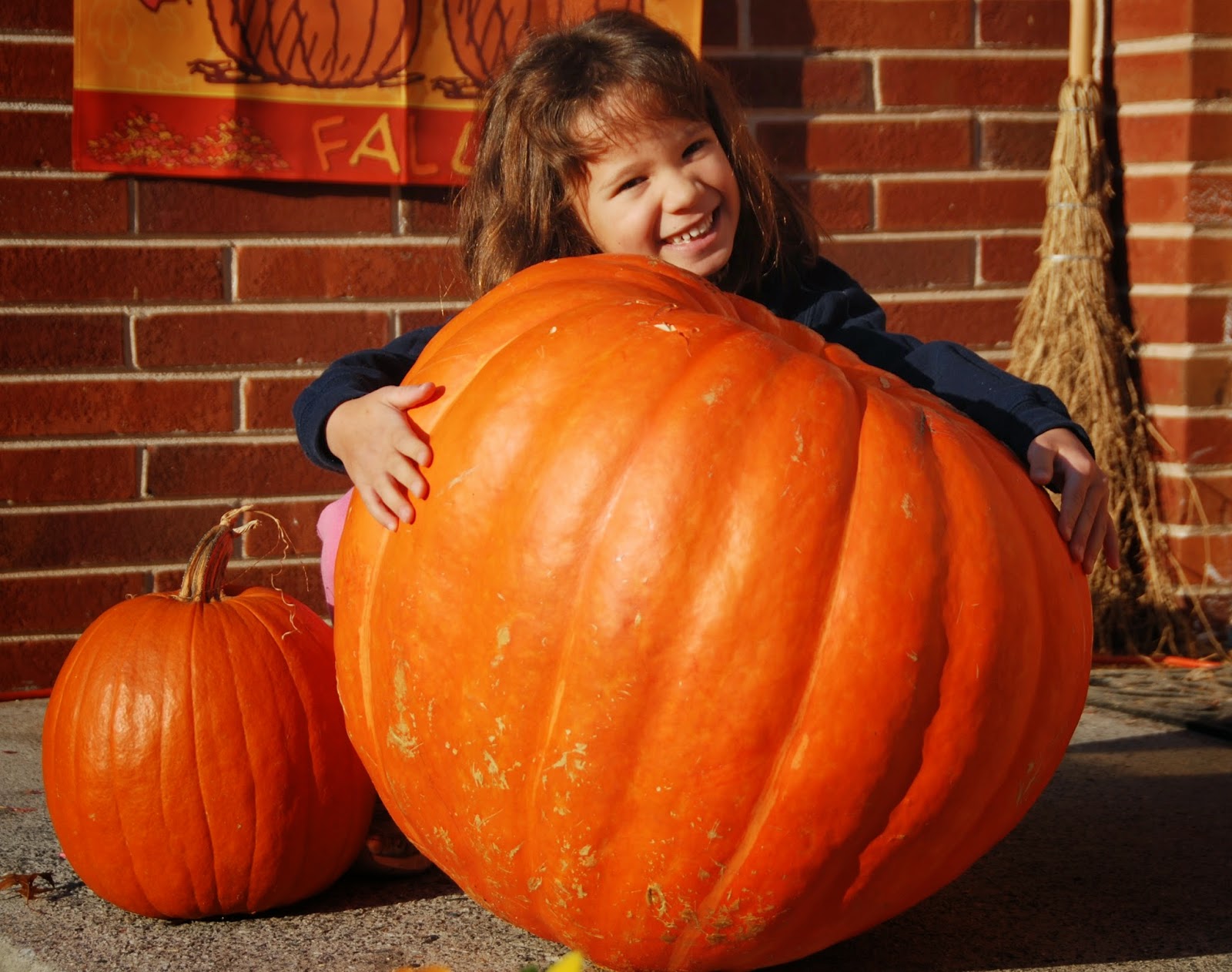
Girl posing with a large pumpkin for Halloween
Young children learn about the passage of time in its earliest form from the daily cycles of morning, afternoon and night. As they grow, they begin to become aware of the yearly seasonal rhythms and cycles. As we now enter Autumn, we enter a time of year where there are many holidays and religious and cultural practices which often have a deep and intense feel about them. Perhaps this ties into ancient practices around the harvest and preparing for the harsh winter. The hours of daylight wind down and cold approaches. Seasonal rituals are important as ways to celebrate the seasons but also as a marker for the passage of time. These rituals give us comfort and create bonds within families and communities.  As adults, we often reflect on the past but as children become aware, they often begin to look forward and to anticipate favorite holidays.
  
We sometimes forget that we don’t have to automatically follow traditions in quite the same way as our family, friends or neighbors. We can create or revive traditions for ourselves that enrich us or bring more depth and meaning to our experience. Now is a good time to reflect and ask ourselves a few questions: What is my favorite part of this holiday? What do I look forward to? What do I dread? What gives me meaning? What interferes with my enjoyment? What do I want to get rid of?

Each leaf lists something that the child is thankful for. Look for new and creative ways to alter, add or pare down, and especially look for ways that children can participate such as helping to make simple homemade gifts of cookies or bath salts. Establish rituals such as eating with lit candles on the table once or twice a week or saying thanks for food before each meal (or singing a song at the end of each meal or before bedtime). In the Autumn, you can create an area where you cut out simple leaf shapes on construction paper and each family member writes what they are thankful for on a leaf and display the leaves. As the weather turns toward winter, my family enjoys cutting snowflakes. We have a stack of prepared white paper cut into 5 x 5 inch squares where each family member cuts out a few snowflakes at a time and we tape them on the dining room windows to display them.  As December progresses, our snowflakes multiply in wonderful and elaborate shapes. As we do this we often reflect upon the snowflakes we created in previous years.  This triggers emotions of times past and helps us to feel a connection to those times and to each other.

So take this opportunity to reflect and choose what matters the most to you and your family and create a holiday season that gives you joy.                     Happy Holidays!

Marla Nargundkar is a Montessori Guide at Tree of Life Montessori School in Atlanta, GA. 

Monday, October 6, 2014

Focus and Concentration


So many children today are diagnosed with Attention Deficit Disorder or variations of this theme. This disorder is tied with a difficulty in the child to focus and concentrate.  Drugs and a change of diet are usually prescribed. Perhaps what is being missed is that focus and concentration are actually skills which must be developed.  According to Montessori philosophy, the best way to do so is to set up the correct environment (and experiences) which provide the child with the opportunity to develop concentration him/herself.
The first step toward building concentration is to find what attracts and interests the child and introduce him/her to some kind of activity that contains a goal in it. For parents, this isn’t difficult since children are naturally drawn to what they most need to learn. The adult should model any steps (and use of tools) and present the goal that is desired. Then the adult must STEP BACK and allow the child the space and time to deeply engage with the activity. It is critical at this stage for the adult to not interrupt, even with praise and encouragement, because this disturbs the child’s inner development.  (Acknowledgment of a child’s accomplishments can be saved until after the child has completed the task.)  Of course, if a task is too difficult, then the adult can give hints or suggestions, but the goal is to let the child work on his/her own. In our hurried, scheduled world, it can be difficult to give children the full amount of time they need to develop this essential skill. As parents and teachers, we must observe for budding signs of focus and then work to protect those delicate (and fleeting) moments.   

Marla  Nargundkar,  AMI Montessori Guide at Tree of Life Montessori School in Atlanta.